Previous evidence on ctDNA-MRD testing has come from clinical trials: the inclusion of ctDNA-MRD testing in the NCCN Guidelines for large B-cell lymphoma (LBCL) [1] and, most recently, the MRD-2 analysis of the GHSG HD21 trial in Hodgkin lymphoma [2]. An equally important question remains: Does ctDNA-MRD testing also work in everyday care, outside of clinical trials, with samples from a wide range of hospitals and practices?
We recently presented our routine diagnostic data for the first time at a major European hematology and oncology congress. The answer is clear, and it matters to physicians and patients alike.
CTDNA-MRD IN BRIEF
How a Tumor-Informed MRD Result Is Generated
Tumor cells release tiny fragments of their genetic material into the bloodstream: circulating tumor DNA (ctDNA). When tumor cells remain after treatment but are not yet visible on imaging (such as CT or PET), this is called minimal residual disease (MRD). A liquid biopsy, a simple blood sample, can capture these traces. It is analyzed with ctDNA-MRD testing in three steps:
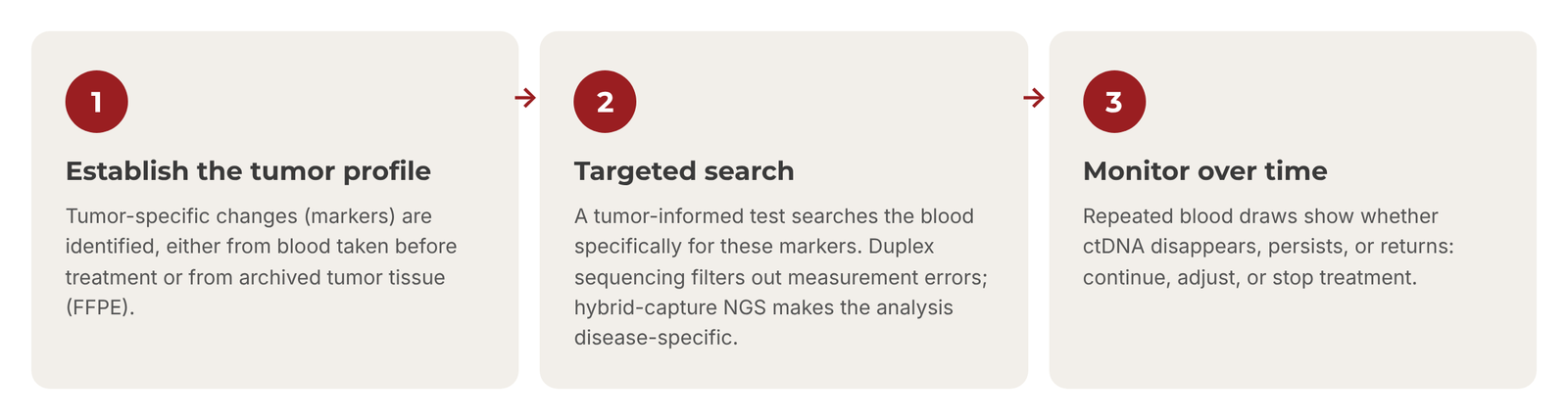
Establish the tumor profile
First, the tumor-specific changes (markers) are identified, either from blood taken before treatment or from archived tumor tissue (FFPE: formalin-fixed, paraffin-embedded tissue, as routinely stored by pathology departments).Targeted search
A tumor-informed test searches the blood specifically for these markers. Duplex sequencing reads both strands of a DNA molecule and thereby filters out measurement errors. Hybrid-capture NGS (high-throughput sequencing that selectively enriches relevant gene regions) makes the analysis disease-specific.Monitor over time
Repeated blood draws show whether ctDNA disappears, persists, or returns. Only the course over time makes MRD a decision tool: continue, adjust, or stop treatment.
CTDNA-MRD IN ROUTINE CARE
Real-World Data at a Glance
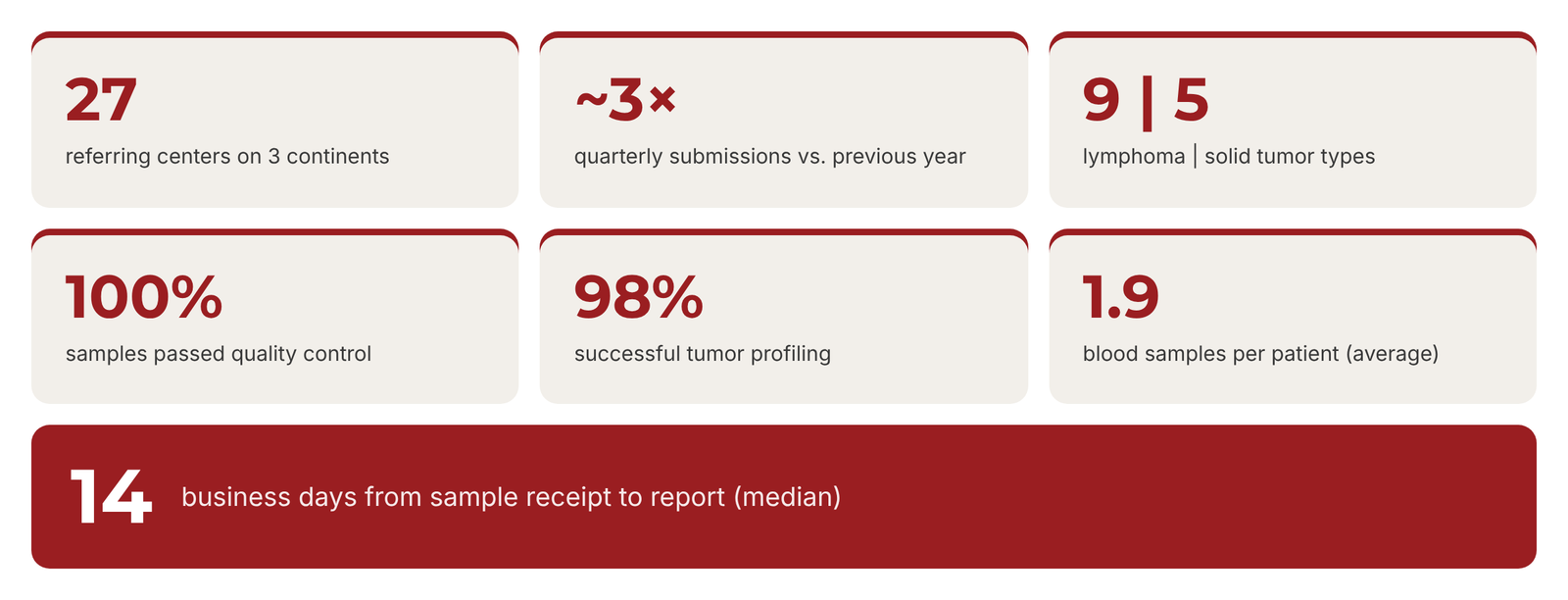
We analyzed all clinical routine submissions for LymphoVista (lymphoma) and CancerVista (solid tumors) through the end of August 2026, excluding research and trial samples.
KEY MESSAGES
What the Real-World Data Show
Broadly applicable
ctDNA-MRD testing is feasible in routine care across a broad range of lymphomas and solid tumors and with different sample types, from blood to archived tissue.Reliable quality under real-world conditions
All samples passed quality control, an informative tumor profile was obtained in almost every case, and reports were delivered within a predictable time frame (see figures above).Analyzed centrally, cared for locally
A centralized laboratory model works in Europe despite international logistics. It safeguards test standardization, consistent bioinformatics (the computer-based analysis of sequencing data), and reporting expertise that low case numbers at individual centers could not sustain. The local care team remains the point of contact and receives the report.The real barrier
The remaining barrier is not logistics or quality, but awareness and reimbursement.
FOR YOUR PRACTICE
What Does This Mean in Practice?
Submit from anywhere: Testing is available to university hospitals, community hospitals, and private practices alike. For the tumor profile, blood in the collection tubes we provide or existing archived tissue is sufficient.
Plan for follow-up: Repeated measurements provide the most information. Follow-up samples should be scheduled at treatment-relevant time points, for example after the first cycles and at the end of treatment.
Support with interpretation: We are happy to support the treating team in interpreting the results.
For patients: Your blood is drawn as usual by your physician, and the sample is then shipped to Cologne. Please discuss with your care team whether ctDNA-MRD testing makes sense in your situation.
CONTEXT
How Does It Compare with PET?
PET remains an established part of lymphoma diagnostics, and ctDNA-MRD testing does not replace it. It complements PET where imaging reaches its limits and can help clarify inconclusive PET findings.
In the GHSG HD21 trial, MRD assessment after two cycles of chemotherapy provided information on relapse risk independent of PET. Many positive PET findings turned out to be negative at the molecular level [2]. For LBCL, the NCCN Guidelines list ctDNA-MRD testing as a possible alternative to repeat biopsy when PET is positive at the end of treatment [1].
What matters most: a test is only as valuable as the decision it enables. Serial MRD assessment answers concrete questions about treatment guidance and helps avoid overtreatment and undertreatment.
Please note: These data demonstrate feasibility and quality in routine operation, not clinical benefit in individual cases.
OUR ASSAYS
(1) LymphoVista
ctDNA-MRD testing for lymphoma
Tumor-informed, tumor profile from blood or tissue. Clinically validated, see note above.
(2) CancerVista
ctDNA-MRD testing for solid tumors
Tumor-informed and technically validated, using the same laboratory and reporting infrastructure as LymphoVista.
The full poster ‘ctDNA-based MRD testing in clinical routine’ with all real-world data is also available from our team on request.

References
[1] National Comprehensive Cancer Network (NCCN). NCCN Clinical Practice Guidelines in Oncology: B-Cell Lymphomas. Version 1.2025, December 2024.
[2] Heger JM, Mattlener J, Kaul H, et al. MRD-2 in the GHSG HD21 trial assessed by a validated circulating tumor DNA sequencing assay. Blood. 2026;147(19):2194-2202. doi:10.1182/blood.2025031089. PMID: 41662627.
[3] Winter J, Rahn A, Pick A, Baum L, Theodorakis E, Zavodnik Š, Borchmann S. ctDNA-based MRD testing in clinical routine: routine diagnostic experience with LymphoVista and CancerVista. Poster, Annual Meeting of the German, Austrian and Swiss Societies for Hematology and Medical Oncology 2026. Data: LIQOMICS laboratory sample register, cutoff August 31, 2026. Source of all figures in this article.